

If you’re an economics grad prepping for UPSC, I’m pretty sure you’ve typed “Indian Economic Service salary” into Google at least a dozen times by now. And let’s be honest , most answers you find online are either too vague or drown you in technical jargon. So here’s a real, straightforward breakdown, what is the actual salary, what the job is really like day-to-day, and whether joining IES is actually worth it or not.
Indian Economic Service Salary Per Month (2026)
Let’s start with the most important part, salary.
The Indian Economic Service salary starts at:
- Basic Pay: ₹56,100 per month
- In-hand Salary: ₹80,000 to ₹1,00,000 per month
This in-hand salary includes:
- Dearness Allowance (DA)
- House Rent Allowance (HRA)
- Transport Allowance
The exact IES officer salary per month depends on your posting city and allowances.
IES Salary Structure & Pay Scale
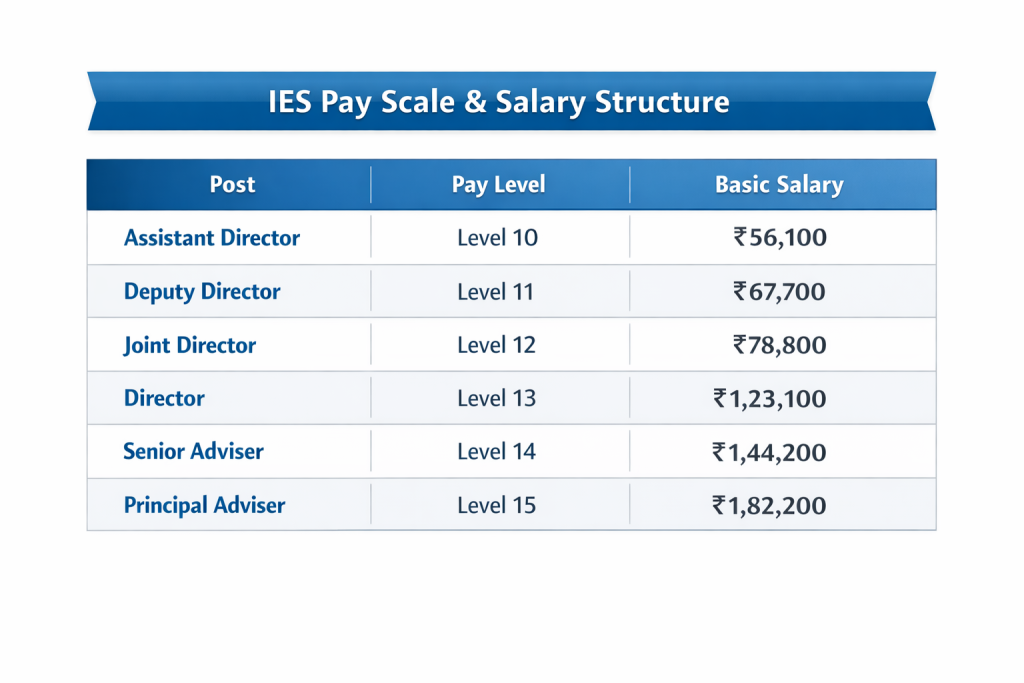
The IES salary structure is based on the 7th Pay Commission and increases with promotions.
Assistant Director → Deputy Director → Joint Director → Director → Senior Adviser → Principal Adviser
At higher levels, your basic salary can reach around ₹1.8 lakh/month. But more importantly, your role becomes much more influential.
Allowances in Indian Economic Service Salary
Your basic pay is just one part of the total package. IES officers receive several allowances:
- Dearness Allowance (DA): Adjusted with inflation
- House Rent Allowance (HRA): If no government housing
- Transport Allowance: Daily commute support
- Travel Allowance (TA): For official tours
- Medical Benefits: For you and your family
These allowances significantly increase the overall IES salary per month.
IES Job Profile: What Does an IES Officer Actually Do?
This is where things get interesting. The Indian Economic Service job profile is very different from IAS. You are not managing districts , butyou are working as an economist inside the government.
1. Economic Data Analysis
A big part of the IES job profile is analyzing data like:
- Inflation
- GDP growth
- Employment trends
- Sector performance
2. Policy Reports & Economic Notes
IES officers regularly prepare:
- Policy briefs
- Economic reports
- Budget analysis
- Scheme evaluation documents
These reports are used by ministries for decision-making.
3. Advising Government Ministries
This is the core of the job.
You provide inputs on:
- Tax policies
- Subsidies
- Economic reforms
- Government schemes
Your analysis directly impacts policy decisions.
4. Policy Evaluation
You also review existing schemes:
- Did the policy work?
- What were the results?
- Should it continue or change?
This makes the IES officer role very important in governance.
5. Forecasting & Economic Planning
IES officers also help in:
- Predicting economic trends
- Estimating growth rates
- Planning long-term strategies
Career Growth in Indian Economic Service
The IES career growth is structured and stable.
Promotion hierarchy:
Assistant Director → Deputy Director → Joint Director → Director → Senior Adviser → Principal Adviser
With each promotion:
- Salary increases
- Responsibilities increase
- Influence grows
At senior levels, you become a top economic advisor.
Posting of IES Officers
Most IES officers are posted in:
- Ministry of Finance
- NITI Aayog
- Economic advisory departments
- Government research organizations
Most postings are in Delhi and are office-based.
Is Indian Economic Service a Good Career?
Yes, especially for economics students.
Reasons:
- High Indian Economic Service salary
- Strong job security
- Direct role in policymaking
- Stable career growth
- Work in top government institutions
How to Become an IES Officer
To enter IES:
- Master’s degree in Economics or related field
- Apply for UPSC IES exam
- Clear written exam
- Pass interview
Our IES Coaching Program
The Indian Economic Service offers a remarkable platform for economists to influence policy decisions and drive national development. Understanding the structure and diverse roles of IES officers is essential for anyone aspiring to join this prestigious cadre.
Preparing for the IES exam requires a clear strategy, strong conceptual clarity, and consistent guidance. At Nishant Mehra Classes, our focus is on building a solid foundation through well-structured courses, updated study material, and expert mentorship, enabling aspirants to approach the exam with confidence.
To learn more about our program and how we can support your preparation journey, explore our Indian Economic Service Coaching Program.